
Best Practices Are Just Average Practices
Embrace the Contrarian Way

I don’t get the obsession with best practices. People always talk about them, likely because none of us really knows what we are doing and the term includes “best.” But if everyone is doing “best practices,” doesn’t that just make them average practices? And if you attempt “best practices” like everyone else, won’t you get the same results as everyone else? They are just the practices that everyone does, average. Best practices can give context, but they are nothing more than a launching point, not an end goal.
“If you play the same game everyone else does, you’ll get the same results everyone else does (mediocre).”
—Alex Hermozi - $100M Offers
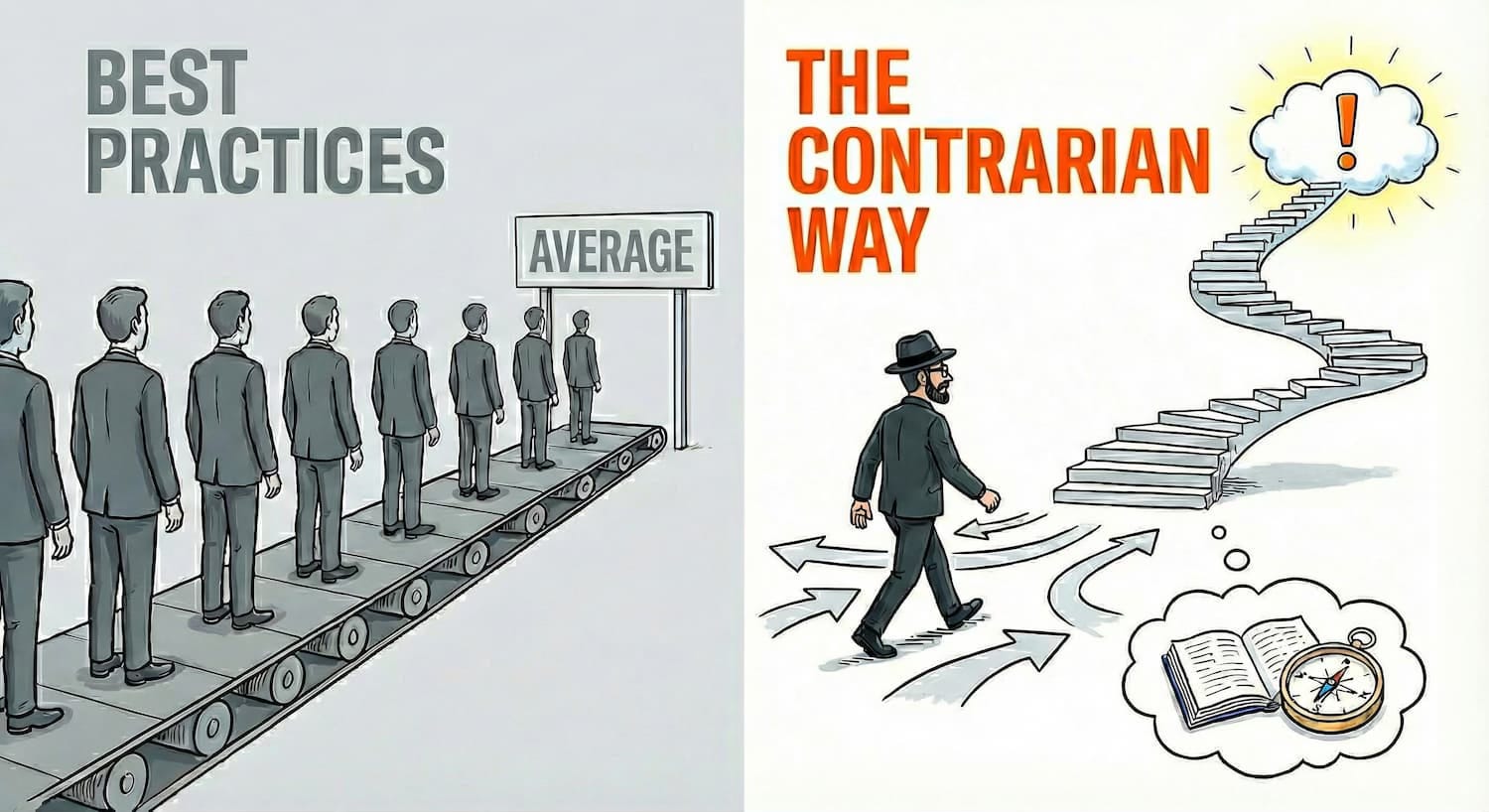
I’ve always found average uninteresting. It’s why I wear a fedora (that and because a cool haircut always eluded me). It’s why I had long hair, tie-dyed shirts, and bright orange Doc Martens in high school. If given the choice of weird or normal, I’m going weird all the way. There’s no such thing as normal anyway, everyone is weird, some of us are willing to admit it when we look in the mirror.
Let’s think about marketing. There are a ton of “best practices” online about how to market. You should post on LinkedIn twice a week. Make sure to be on the social platforms where your people are. Build an email list and send out a newsletter. Rules, rules, and more rules.
The problem is, all of the marketers are reading the same rules, or chatting with AI bots that read those rules and regurgitate them. And thus, a lot of marketing looks the same, and much of it barely moves the needle. It’s average. Boring.
I tell marketers, and really anyone who will listen, the opposite. Ignore the rules. Do what is contrary, off the wall, unexpected, and wild. Not random. Not reckless. But thoughtfully different. Commit to a daily podcast, 10 TikTok videos a day, 30 LinkedIn posts a week. Do 10X or 100X more than everyone else, see what works, and then double down on it. Not all at once, and not forever, but long enough to see real signal instead of noise. You will learn faster and be able to move 10 times faster than anyone else. Pick something, and do more of that thing, at a higher quality, than anyone else.
In The 4-Hour Workweek, Tim Ferriss writes, “If everyone is defining a problem or solving it one way and the results are subpar, this is the time to ask, What if I did the opposite? Don’t follow a model that doesn’t work. If the recipe sucks, it doesn’t matter how good a cook you are.”
Best practices are the recipe that sucks (especially in marketing). They are the rules that lure you into the vortex of the average and never let you go. The ONLY way to be exceptional is to be actually exceptional.
Being exceptional means doing what other people are unwilling to do. It means doubling down on a strategy you aren’t sure will work, but is worth a shot. It means trying new things, failing over and over, and trying again anyway. Every success story has followed this path.
Being exceptional is getting into a crowded elevator and not turning to face the door. It’s awkward as hell, but you better believe people will talk about it later. When I first started wearing a fedora daily, it was awkward. I wasn’t sure what people would think of it, or me. I wasn’t sure where it was appropriate to wear and where it might not be. Going to a networking meeting and being the only doofus in a hat was weird, and a little nerve-racking... until it wasn’t. It just kinda worked. Then, it became my personal brand.
I got over the awkwardness. I was able to fully embrace the uniqueness of my style and approach. And in doing so I created a personal brand that is more powerful than most realize. When people see me, they remember me, because they know the hat. At events, people remember me because of the hat. On social timelines, people recognize me, because of the hat. I get texts and emails from friends in hotels with a fedora display because it made them think of me. Believe it or not, I get complimented on my hat 75% of the time I go out in public, by young and old alike.
The hat wasn’t the strategy. Commitment was. I picked something visible, stuck with it long enough for it to feel normal, and let consistency do the work.
People admire contrarians, but are nervous to become one. They love the guy in the hat enough to say “nice hat” to a complete stranger, but not enough to put one on themselves. And that, my friends, is the power in going against the norm and abandoning best practices. People respect it, even admire it, while all the time they are unwilling to do it themselves. That gives the contrarian an edge that no one else has.
What are you doing (in marketing or elsewhere) that is a best practice? And is it really helping you, or just keeping you afloat in a sea of average? It’s time for new thinking. It’s time to be contrarian and pave a path that works for you.
If this challenged a ‘best practice’ you’re following, send it to someone else who’s stuck in the same pattern. We are just getting started. Thanks.
Best practices are valuable...but primarily as a starting point or baseline to help get an idea off the ground. They’re useful for spotting trendlines and providing context, but they shouldn’t become the main guiding principle for your work. Leaning on them too heavily often leads to the “boring” outcomes you mentioned. It reminds me of a quote: “Rules are for the obedience of fools and the guidance of wise men.” Use best practices as guidance, not as a cage.
Love this Adam. Huge part of my 2026 👉🏻
“Pick something, and do more of that thing, at a higher quality, than anyone else.”